With the enhancement of IoT technology, health awareness and the demand for home integration, smart toilets are evolving from functional bathroom products to “health management centers” in American households. The market size of smart bathroom products in the United States is projected to increase from 1.6 billion US dollars in 2024 to 3.5 billion US dollars in 2033, with a compound annual growth rate of 10.7%. This growth is driven by consumers’ upgrading demands for hygiene, comfort and energy efficiency, as well as the accelerated popularization of the smart home ecosystem.
Market Rise: From High-End Luxury to Mass Demand
The penetration rate of smart toilets in the United States is still in its early stage (about 2.5%), but the growth momentum is strong. Nearly 40% of renovation homeowners plan to install smart toilets, and new residential buildings and high-end commercial projects have made them a standard configuration. The driving factors include:
Health and hygiene needs: In the post-pandemic era, non-contact operations (such as automatic lid flipping and flushing) and self-cleaning functions have become core selling points. In 2022, 39% of American consumers replaced their traditional toilets due to hygiene issues.
Smart home integration: The number of smart home users in the United States has reached 57.5 million, with a penetration rate of 43.8%. Smart toilets have become the interaction entry point in the bathroom scenario through the linkage with voice assistants and mobile apps.
Water-saving policies drive: The WaterSense certification and energy efficiency standards of the US Environmental Protection Agency (EPA) have prompted enterprises to accelerate the development of water-saving products. For example, the single flush volume of some smart toilets has been reduced to 1.28 gallons, far below the federal standard of 3.5 gallons.
Technological evolution: From basic functions to personalized management
The technological evolution of smart toilets is centered around two main directions: intelligence and personalization:
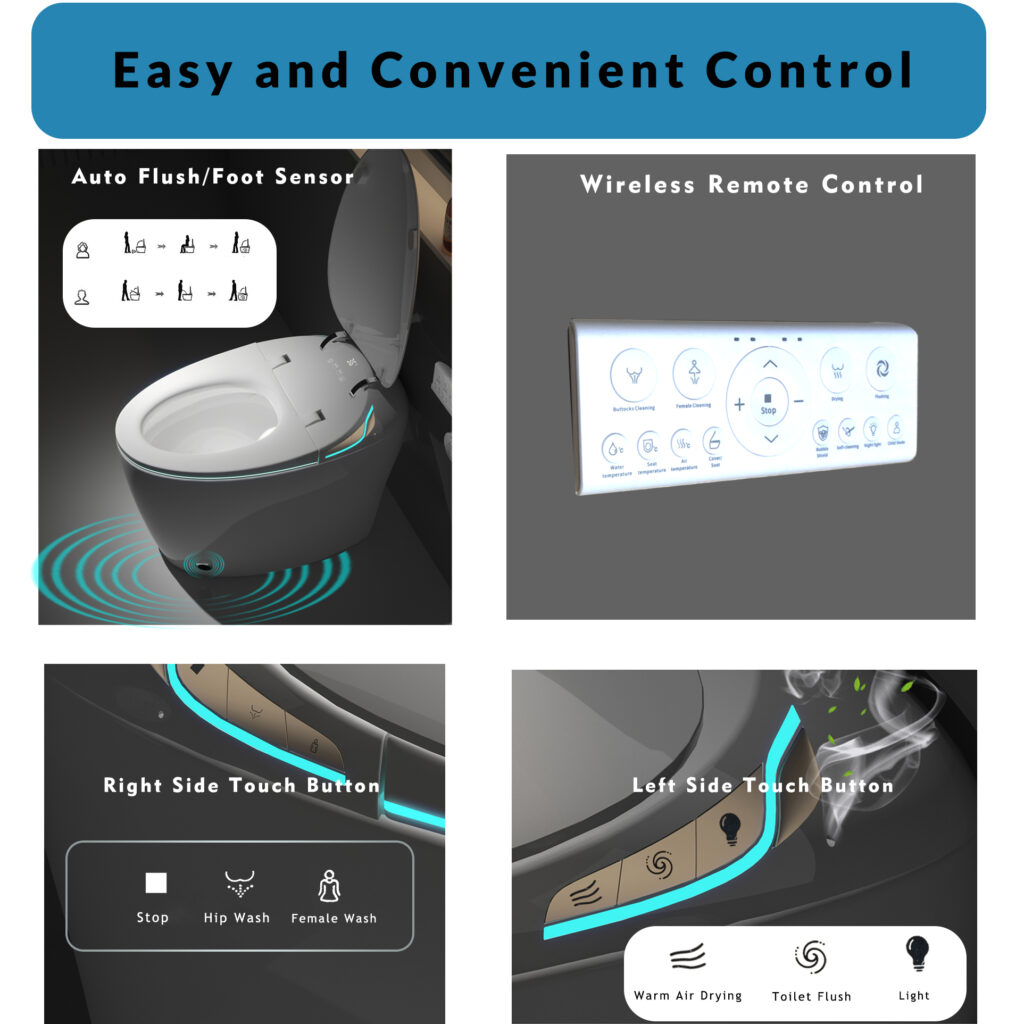
Our BWBT Series smart toilet features the following basic functions:
Seat heating, warm water cleaning, and warm air drying have become standard features.
Non-contact technology: functions such as foot-feel flip covers and intelligent deodorization cover the entire toilet usage process, reducing the spread of bacteria.
Energy-saving and environmental innovation:
Instant heating replaces the storage water design, avoiding the accumulation of scale and extending the product lifespan.
The intelligent water flow control system optimizes the flushing mode based on usage habits, and some products can reduce household water consumption by more than 30%.
Consumer group: All age groups and differentiated demands
The users of smart toilets in the United States exhibit diverse characteristics, and the design of functions needs to be tailored to different groups:
Young families: They focus on intelligent experiences (such as voice control, scene linkage) and design aesthetics, and are willing to pay a premium for technological advancements.
Middle and high-income groups: They value brand and technological barriers, and prefer high-end models with integrated health monitoring.
Senior users: Their needs mainly concentrate on safety assistance (such as assistive standing mechanisms, anti-slip designs) and simple operation. With the aging of the United States population increasing, there is great potential for age-friendly products.
Future Trend: The Core Node of the Intelligent Bathroom Ecosystem
The future of smart toilets will go beyond being a single product and evolve into a fully integrated smart solution across various scenarios:
Deep integration with smart home: By connecting the shower system, mirror cabinet, and lighting through a unified platform, personalized scenarios in the bathroom space can be achieved.
Sustainability upgrade: Using renewable materials (such as recycled ceramics) and energy-saving technologies, it aligns with EPA and WaterSense standards.
Expansion in commercial scenarios: In hotels and medical facilities, smart toilets automatically adjust settings through facial recognition, enhancing the hygiene standards of public spaces.
The intelligent transformation of American residential bathrooms is essentially an industrial upgrading driven by technology, demand and policy. In the US market, it is shifting from an “optional luxury” to a “necessity for health and efficiency”. With the reduction in costs and standardization of technology, in the next five years, smart toilets are expected to become a standard feature in American households, redefining the boundaries of daily hygiene and health management.
Whenever friends come over for a gathering, they always fix their eyes on the wine rack on my wall and ask, "What an amazing design! It’s so atmospheric!" In fact, it’s more than just a wine rack—it’s a tiny landmark in my home. With Gothic point...
Walk into most American bathrooms, and you’ll spot the same frustration: cluttered countertops buried under shampoo bottles, skincare tubes, and dental essentials. We crave storage that works with our space—not against it. Enter GoodQualityB...
Although bathroom pendant sets only constitute a small part of the bathroom space, they are the crucial link connecting functionality and aesthetics. A bathroom pendant set that includes hooks, towel rods, towel rings, toilet paper holders, etc....
In the context of increasingly tight urban living spaces and the accelerating trend of aging, the design of bathroom spaces is undergoing a silent but profound transformation. Particularly, the toilet, a daily necessity, is evolving in two seeming...
 Goodqualitybuy


HelloPlease log in